Sarkar Tactical — system reference
The internal ops platform. Orders, production, materials, trim sheets, compliance, packing, shipping — all on one server, reachable from any browser on the LAN. This page is a quick reference for what’s where and how the parts fit together.
Scope Modules
Each module is one operational area — its own pages, REST endpoints and database tables. Roughly a dozen, covering goods-in through to the commercial invoice.
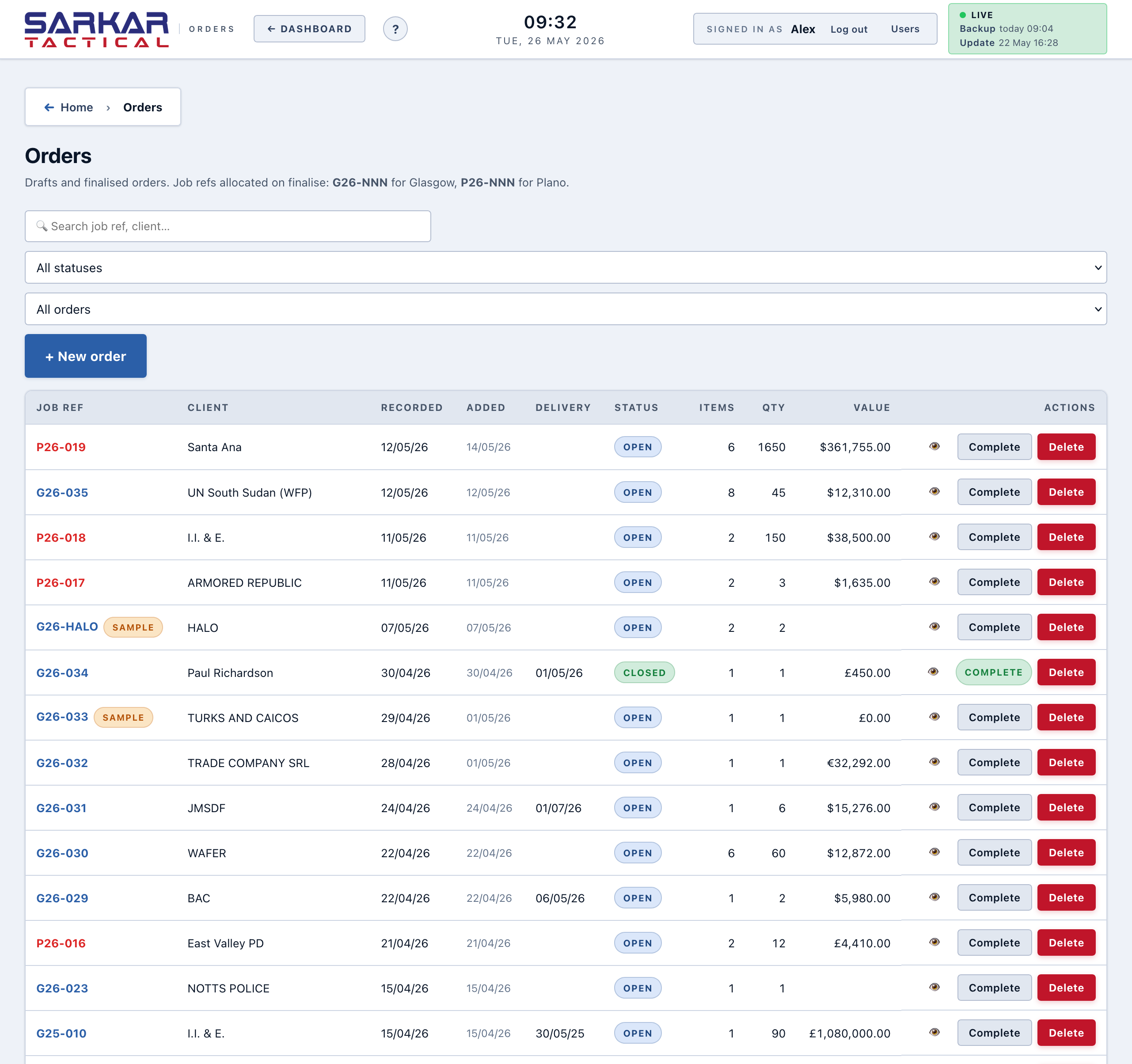
Orders & fulfilment 10 pages
Draft → finalised → produced → shipped lifecycle with transactional job-ref allocation and full attachment + checkpoint history.
- Drafts with autosave, finalisation locks the ref
- Line items, serials, file attachments, memos
- Stage checkpoints + production timeline
- Inline parcel logging, no navigation
Catalogue & products 8 pages
Three-tier hierarchy (category → item → variant) with bill-of-materials, usage costs, fabric/net/gross weights, ML rating, HS code, warranty & certificate of conformity tracking.
- Per-variant rolling stock + reorder triggers
- Copy / merge tools that preserve link integrity
- Inline image upload + recipe-book PDF export
Production sheets 3 pages
Helmet, ballistic and carrier job sheets with auto-allocated serials, profile presets, material override per line, save-as-new-recipe one-click.
- Pool-aware serial allocation (custom 3-letter pools)
- Cross-link to source order from any sheet
- Profile picker → auto-fill, amber-glow blanks
Materials & trims 6 pages
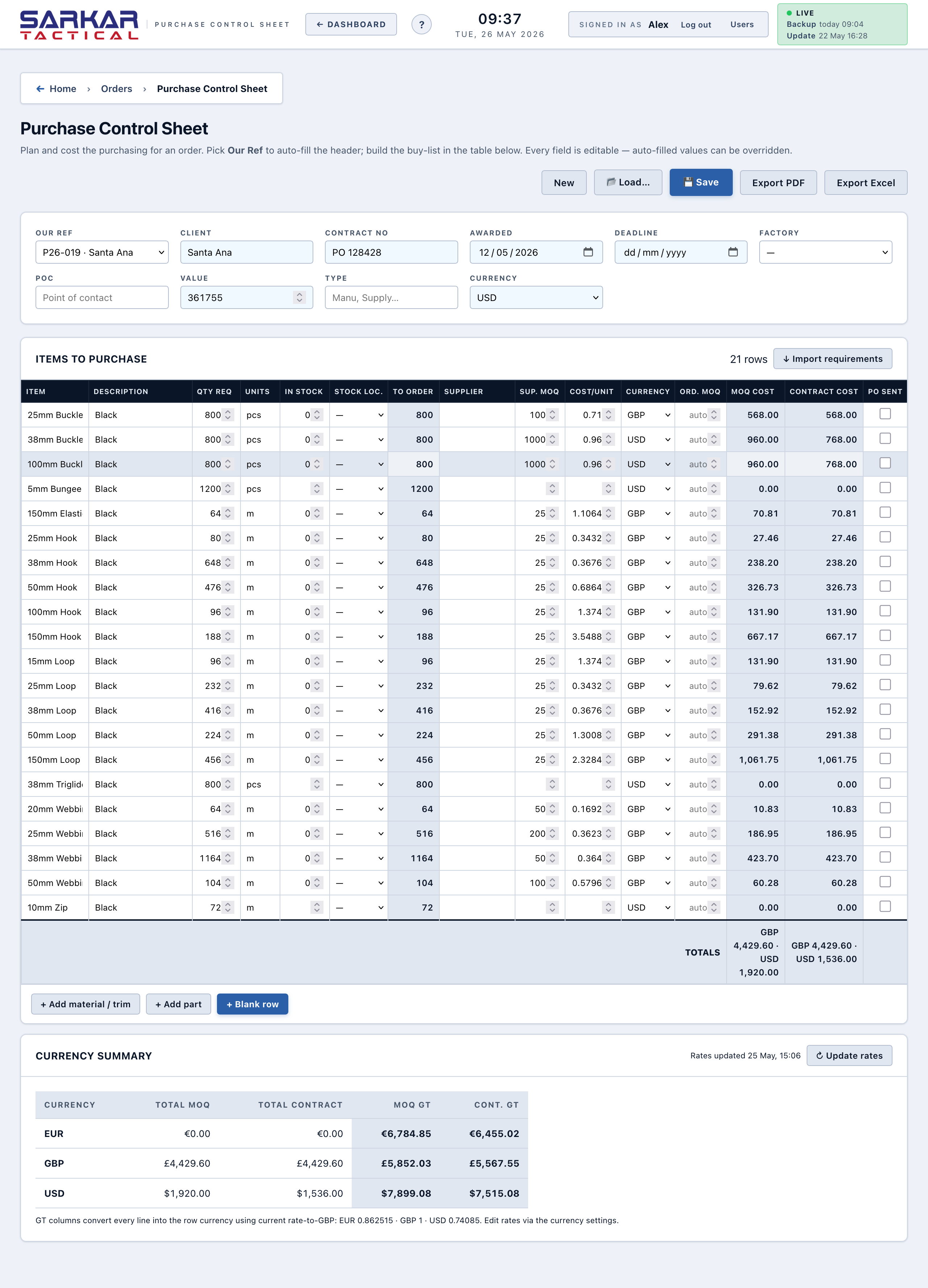
Per-roll fabric stock, ballistic panels, and a parallel trim-stock world (webbing, hook/loop, buckles, zips, elastic, bungee).
- Idempotent imports from supplier price lists
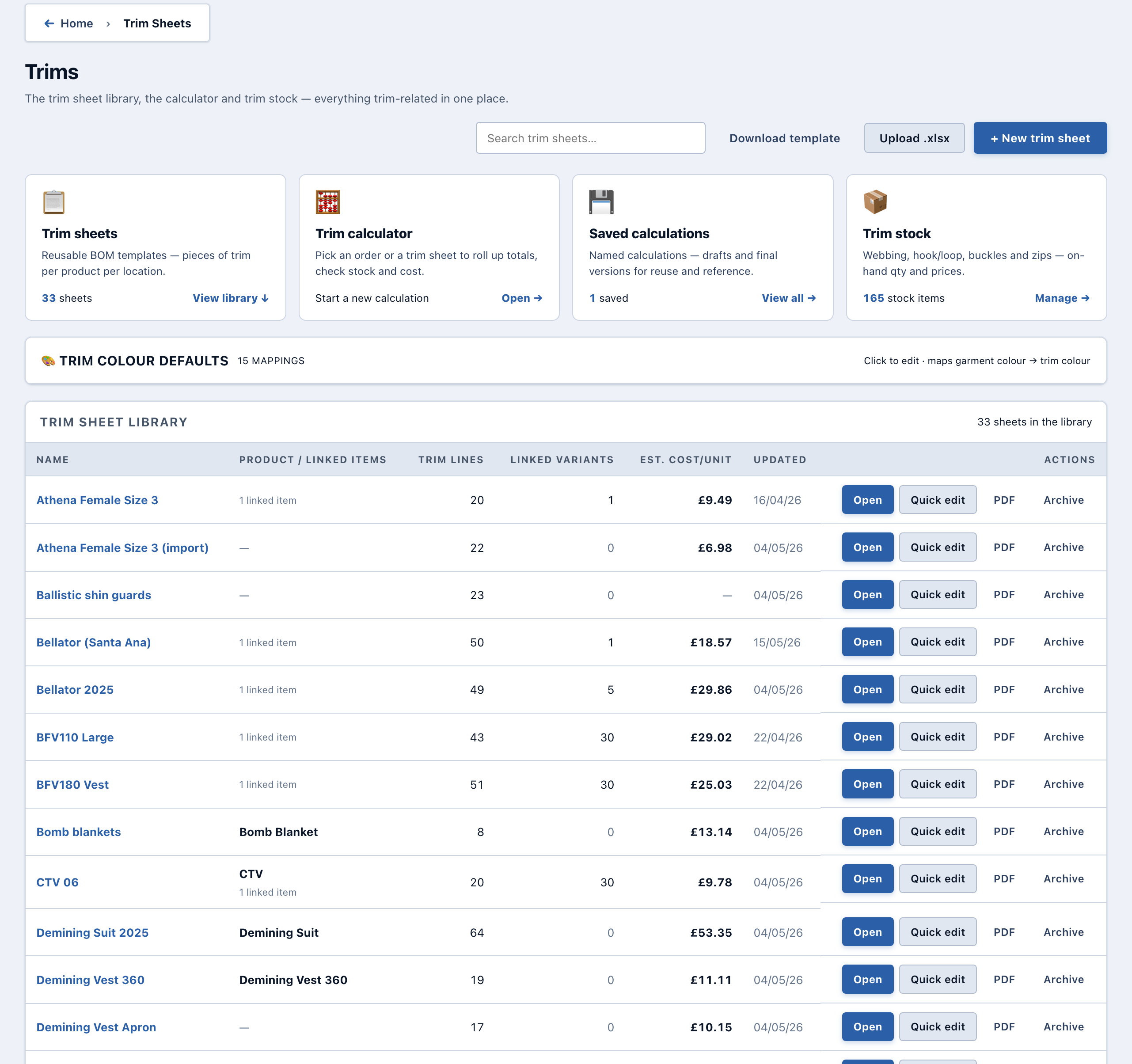
- Trim sheet library — reusable BOM templates
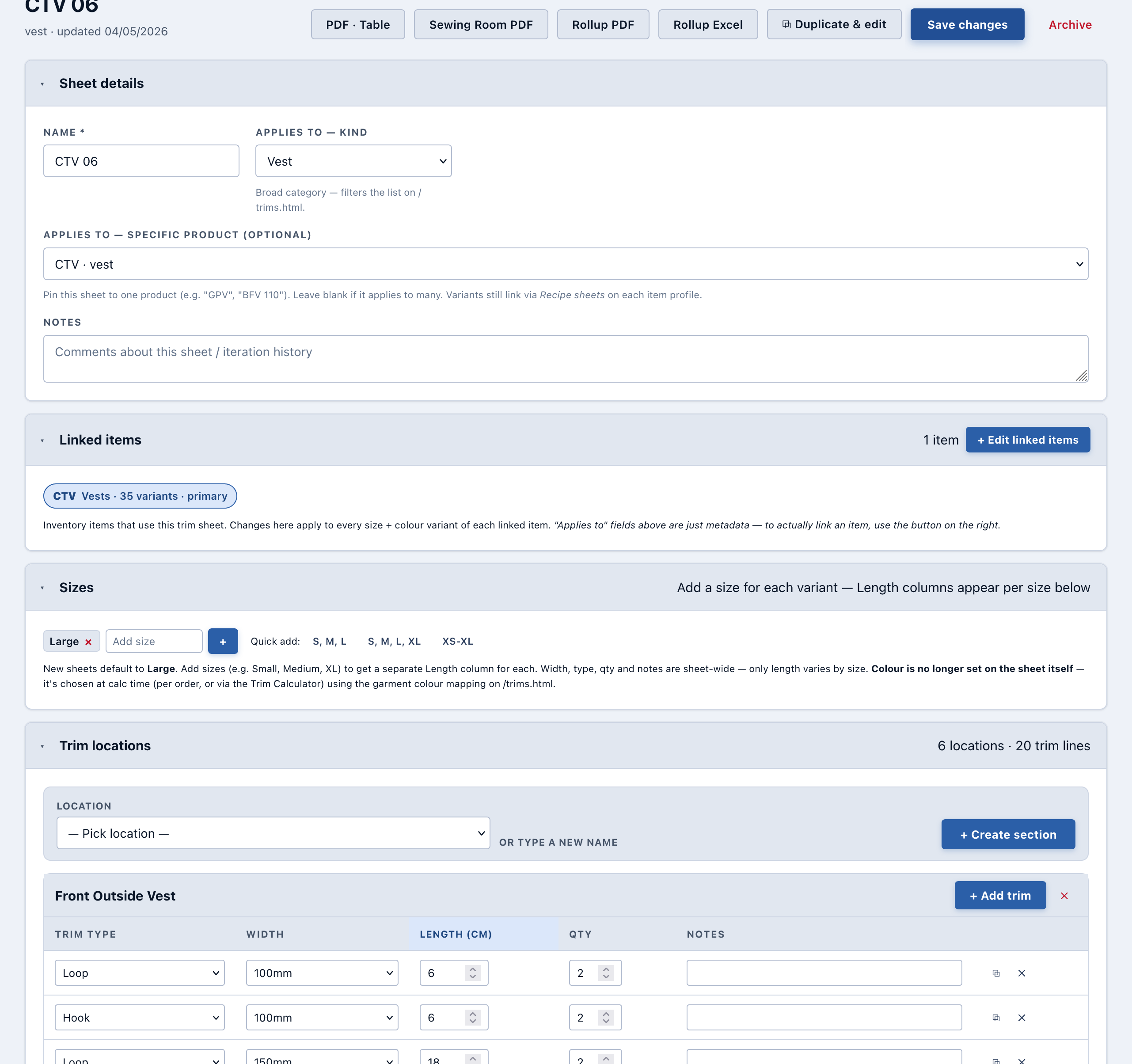
- Per-size length columns, colour-agnostic recipes
Export compliance 5 pages
UK ECJU SIEL / OGL handling, ML ratings, HS codes, end-use certificates & per-shipment licence draw-down.
- US/Plano standing SIEL with 7-product allow-list
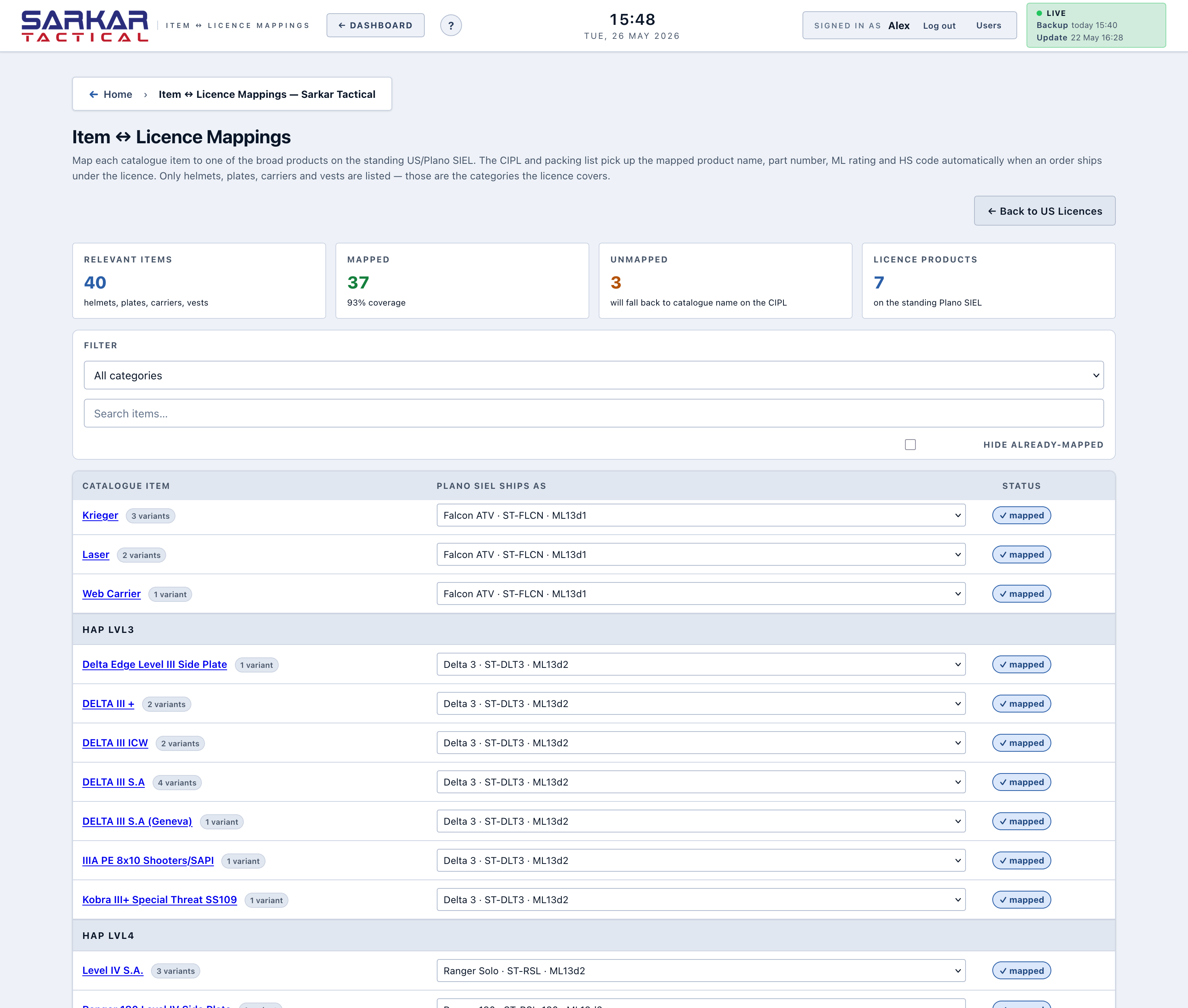
- Item ↔ licence-product mapping (custom → broad)
- CIPL generator with auto-licensed naming
Packing & pallets 4 pages
Draft + final packing lists, box fit-matrix suggestions, pallet nester with 3D-aware stacking constraints, weight rollup.
- Order import — PCS/CTN pre-filled from line qty
- Landscape PDF exports with TOTALS rows
- Pallet packing limit configurable per order
Stock & serials 6 pages
Movement ledger (in/out/transfer), labels grid, custom serial pools, allocation classifier, sticker-sheet PDFs.
- Pool-aware allocation (default labels per pool)
- Right-click context menu on serials in orders
- Print queue / Printed log dual PDF exports
Memos & meetings 2 pages
Operations meeting notes with anchored job-ref references — click any ref in a memo to open the order in a new tab.
- Legacy spans auto-upgraded to clickable anchors
- Per-order "Related memos" section on every order
Pricing & quotes 4 pages
Catalogue-driven pricing with currency conversion, weight-based freight estimates, two-pass cost calc with QB lookup fallback.
- Currency defaults from order header
- Costing snapshot per quote (audit-friendly)
Compliance & quality 3 pages
Order checkpoints (Received → Licence → Plan → Manufacturing → Finishing → Shipping), CoC documents, inventory checks, data audit.
- Auto-flagged missing-data rows in catalogue
- Per-order checkpoint tick history
Operator stations 5 pages
Kiosk-friendly station views for warehouse, sales, materials — large tap targets, role-based landing pages, 4-digit PIN login.
- Sales station: pick an order, fulfil, print labels
- Warehouse: log deliveries, scan barcodes, mark printed
Visualisation 3 pages
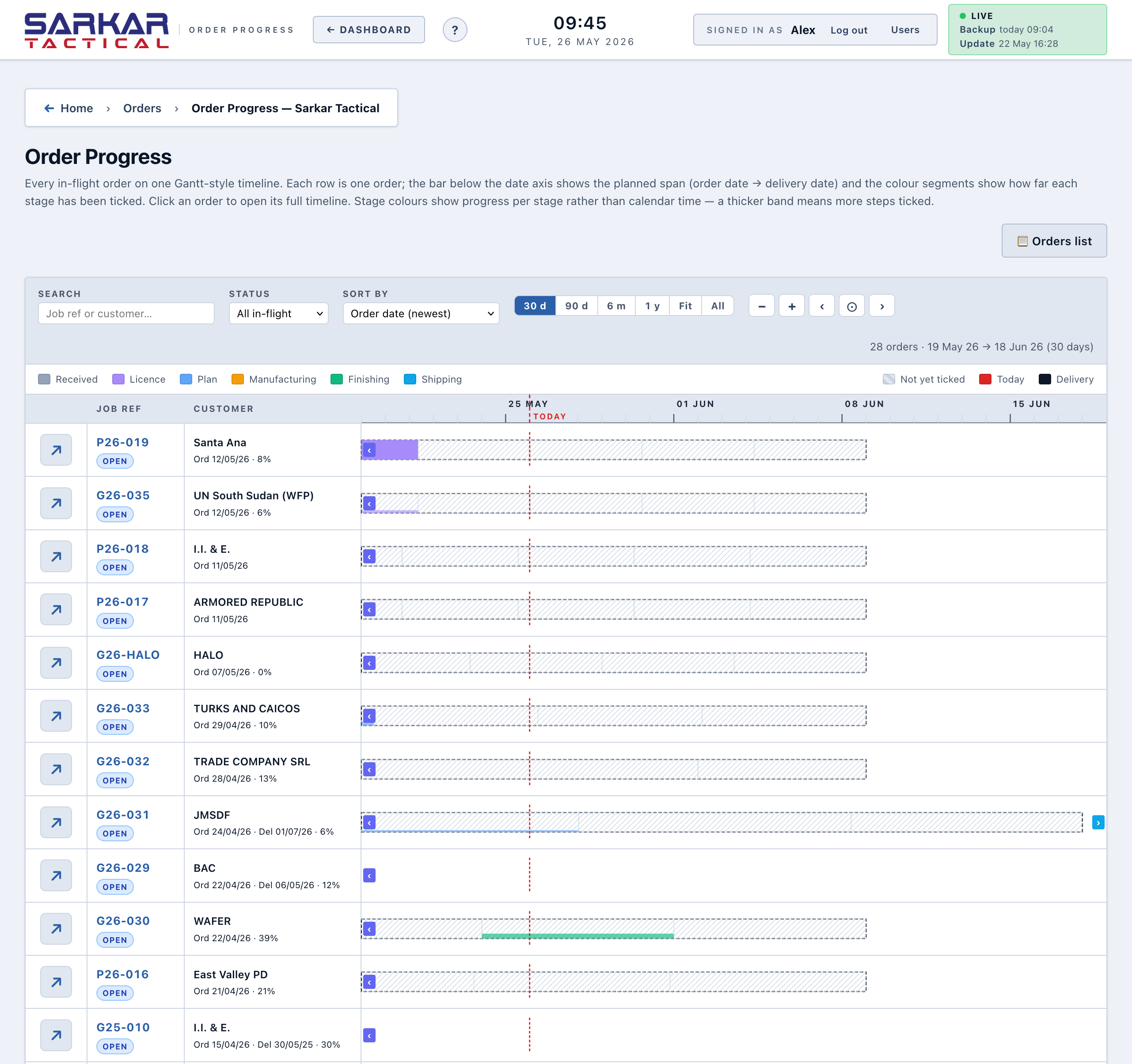
Gantt-style order-progress timeline with stage colours, drag-to-reorder, range presets and zoom; pallet nester preview; PDF previews on every job sheet.
- Responsive SVG axis locked to row bars
- Stage segments coloured by completion %
Stack Architecture
Vanilla ES modules in the browser, Node + Express on the server, MySQL for state. No build step, no bundler, no framework dependency tree.
Stack at a glance
Node.js Express MySQL 8 mysql2/promise Vanilla JS (ES modules) Native Web Components CSS custom properties jsPDF (lazy) multer (uploads) Ubuntu systemd rsync + SSH Cloudflare Tunnel USB rolling backups
Views Selected views
HTML/CSS renderings of production views — same components, colours and typography as the live app. The URL in each frame links to the actual page.
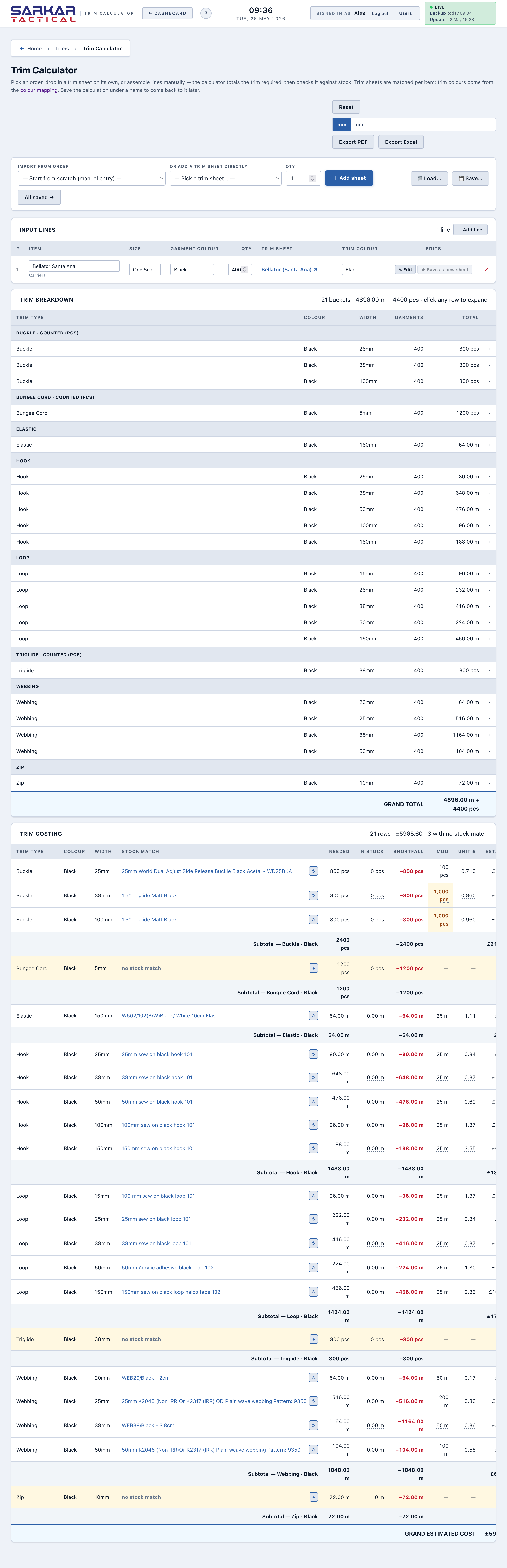
Trim sheet — reusable BOM template with per-size lengths
| Trim type | Width | Length (cm) | Qty | Notes |
|---|---|---|---|---|
| Buckle | 25 mm | — | 2 | Side-release buckle |
| Webbing | 38 mm | 7 | 2 | |
| Webbing | 25 mm | 8 | 2 | |
| Buckle | 38 mm | — | 2 | Shoulder ROC buckle |
| Loop | 15 mm | 24 | 1 | |
| Webbing | 38 mm | 7 | 4 | |
| Buckle | 100 mm | — | 2 | Waist ROC buckle |
| Zip | 10 mm | 18 | 1 |
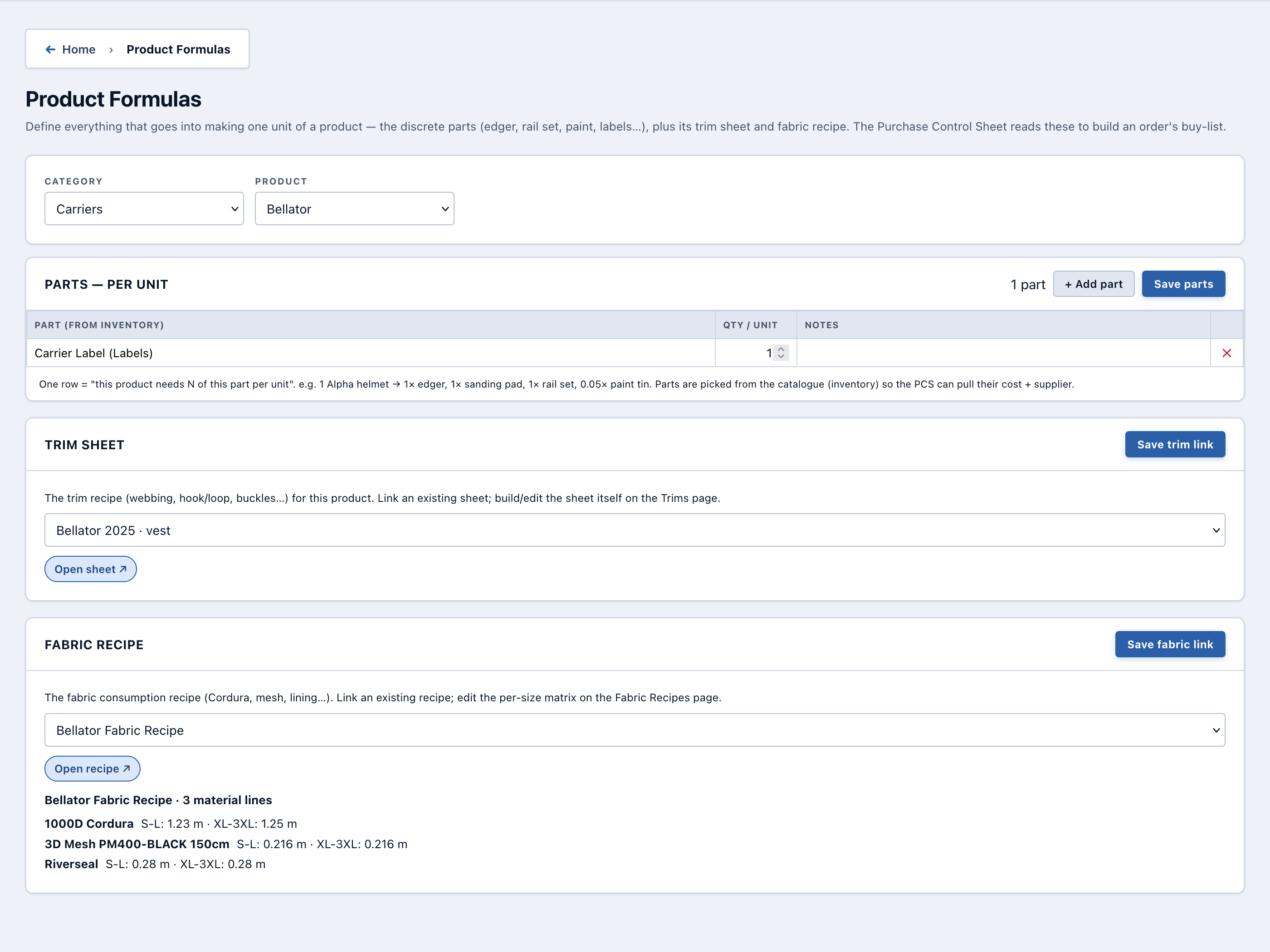
Eight sections covering the full carrier. Stored once; referenced by any order that needs a Bellator.
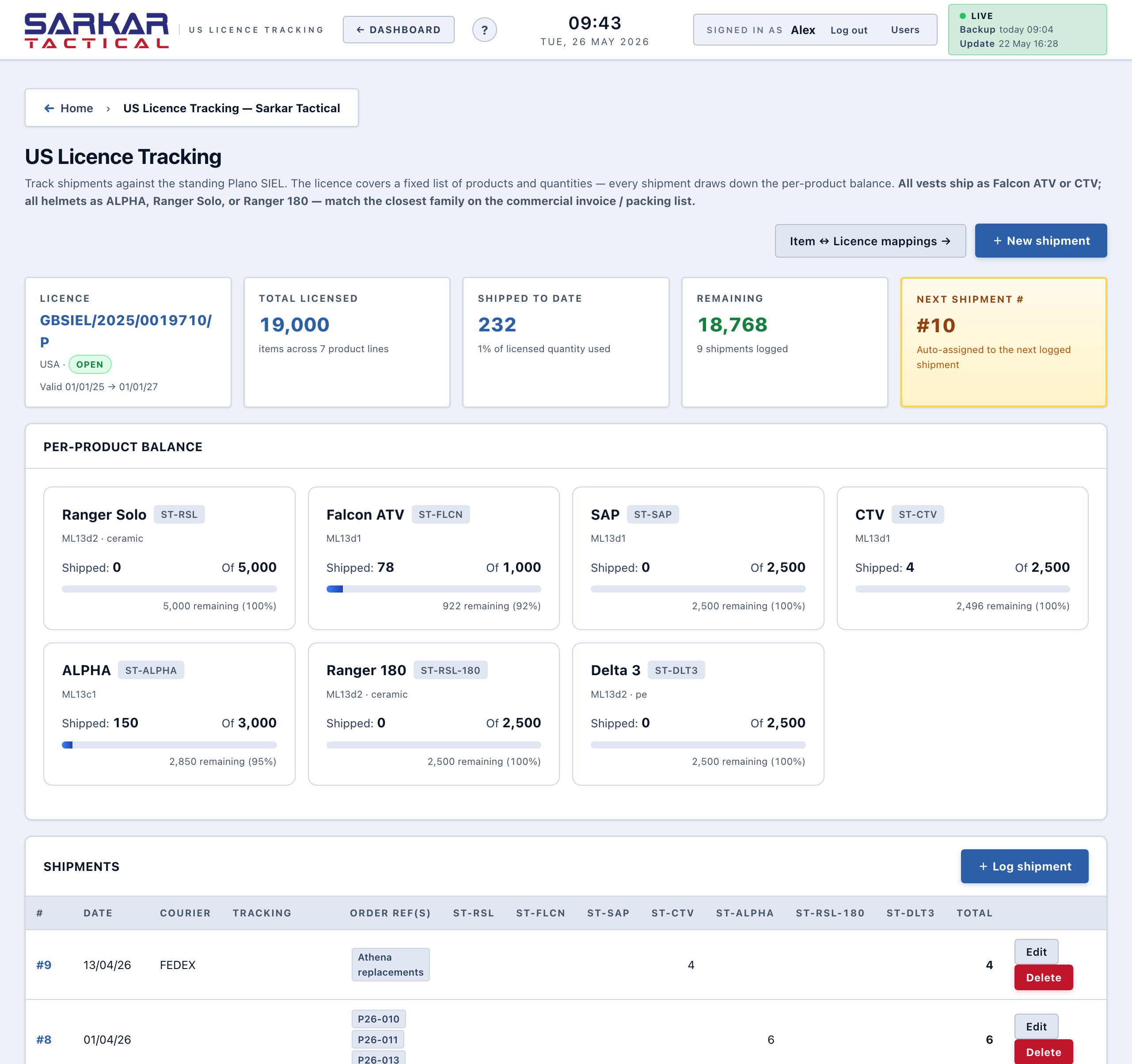
US/Plano SIEL — per-product balance with shipment ledger
Falcon ATV · ST-FLCN
ALPHA · ST-ALPHA
CTV · ST-CTV
Ranger Solo · ST-RSL
us_licence_shipment_items joined to the licensed quantity — every logged shipment draws the per-product remaining down. Custom catalogue items (GPV, Bellator) ship as the closest licence family via a mapping table that’s read at CIPL-generation time.
Transactional ledger; read-time balance roll-up. The old multi-tab Excel tracker still exists as a backup.
Order progress — Gantt-style timeline with stage colours
Six-segment bars; segment fill = proportion of stage checkpoints ticked. Drag a row to reorder; scroll-wheel zooms.
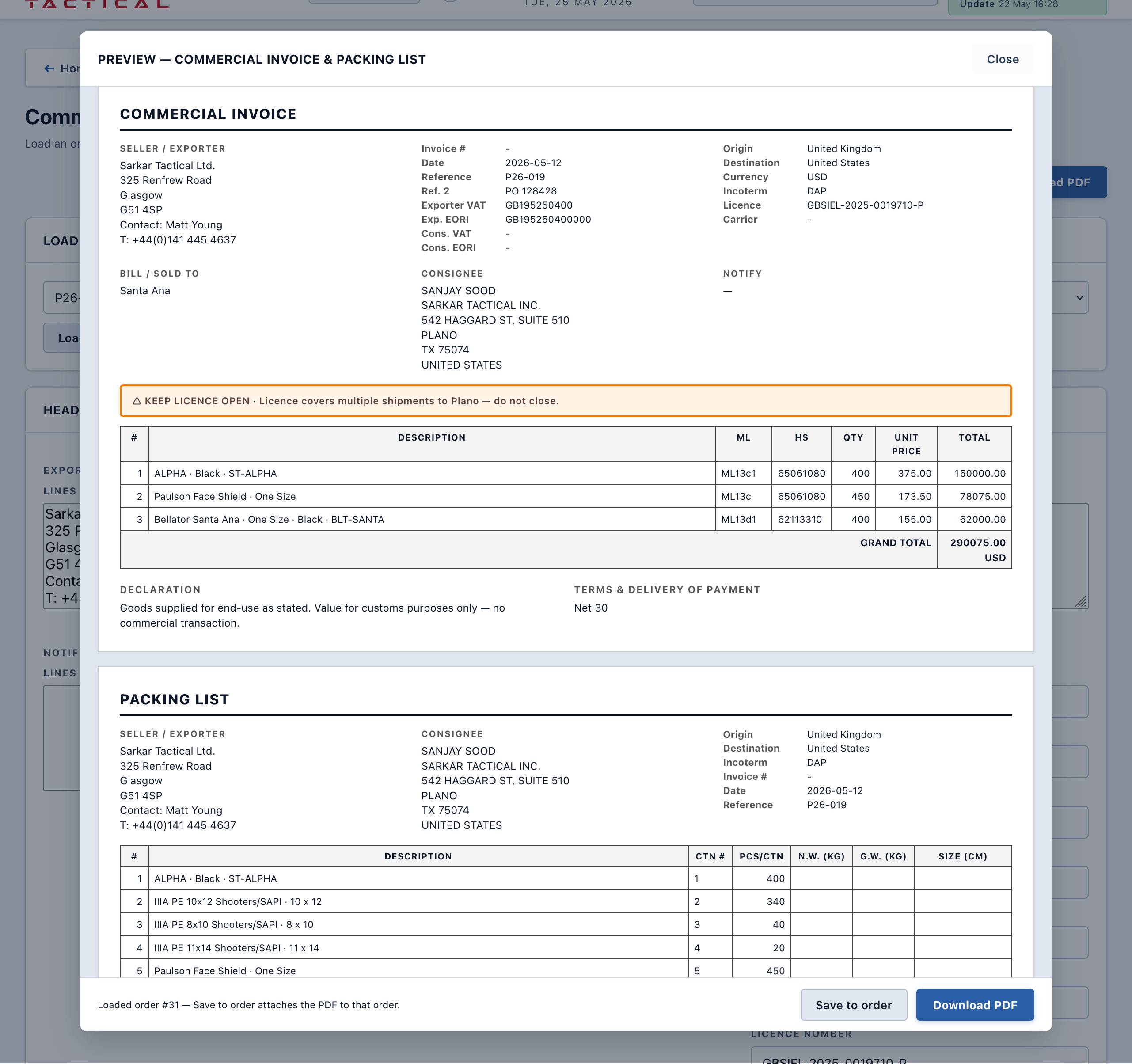
Commercial invoice + packing list (CIPL) — one button, two-page PDF
GPV → Sarkar Falcon ATV) with the
correct ML rating + HS code from the licence product, not the
catalogue item — one of the few places where the system
actively rewrites your data on output to keep customs paperwork
accurate.
One button; catalogue-name → licence-family rewrite happens at render time.
Ops Deployment
Deploys via a single shell script over SSH. Backups run hourly to a USB drive with rolling retention. Public access via Cloudflare Tunnel when needed.
One-command deploy
A single ./push.sh rsyncs the repo to the production server over SSH, runs npm install --omit=dev only when package.json changes, restarts the systemd service through a NOPASSWD sudoers entry, and polls /api/health for up to 10 s before declaring success. Total time: ~6 s for a frontend-only change.
Hourly USB backups, rolling retention
Cron-driven mysqldump + tar of backend/uploads to an external USB drive, with 48 hourly + 14 daily + 12 monthly snapshots kept. Survives Dell hardware failure without touching the cloud.
Public access via Cloudflare Quick Tunnel
The internal-only LAN URL is fronted by a Cloudflare tunnel for off-network access. No port forwarding, no static IP, no firewall changes on the office router.
Health check & restart guards
Every deploy ends by polling /api/health for up to ten seconds; if the new build doesn’t come back, the script exits non-zero and prints the journalctl tail. Service is supervised by systemd with Restart=on-failure so a crash doesn’t take the warehouse offline overnight.
Role-based 4-digit login
Auth is a 4-digit PIN per user with role-keyed landing pages: admin → dashboard, sales → sales station, cutting → cutting log, stock → warehouse station. Keeps kiosk machines locked to a single screen by default.
Audit trails on critical mutations
Order status changes, stock moves, and serial allocations all carry a created_by stamp pulled from the X-Sarkar-Employee header. The data-audit page reads the trail back as a single ledger.
Deployment flow
Pages Live pages
A handful of pages worth opening directly. Each is one HTML file plus shared modules, backed by its own endpoints and tables.
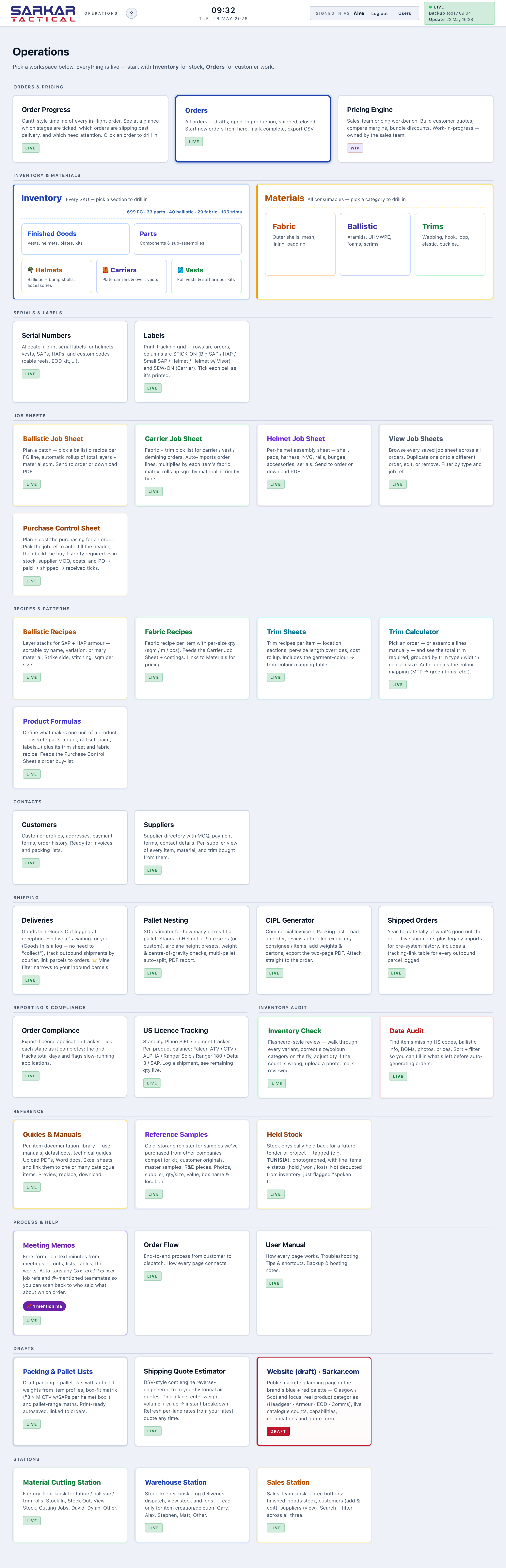
Dashboard
The numbered-tile home page. Role-aware landing. Composite tiles for Inventory and Materials with nested shortcuts.
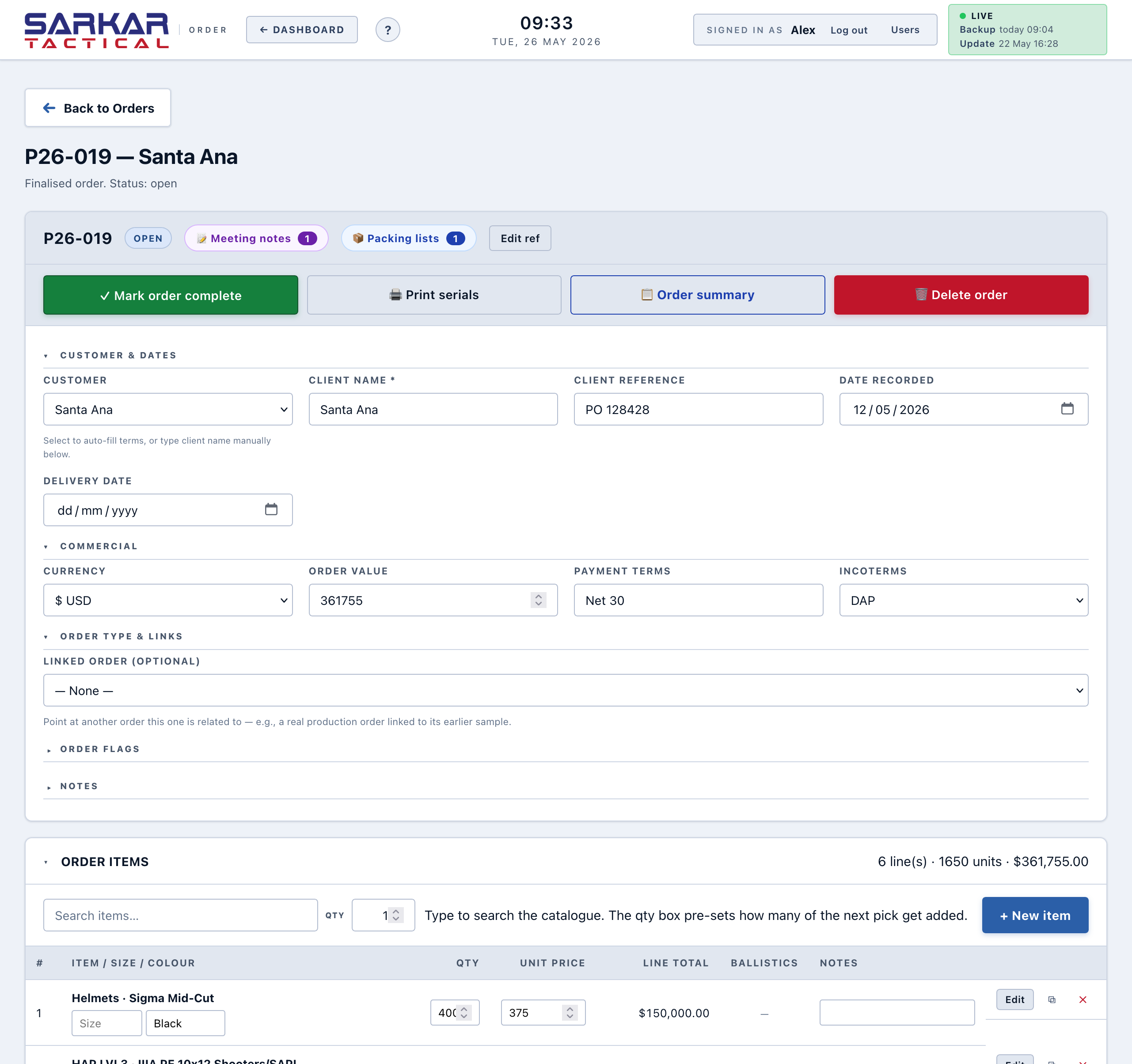
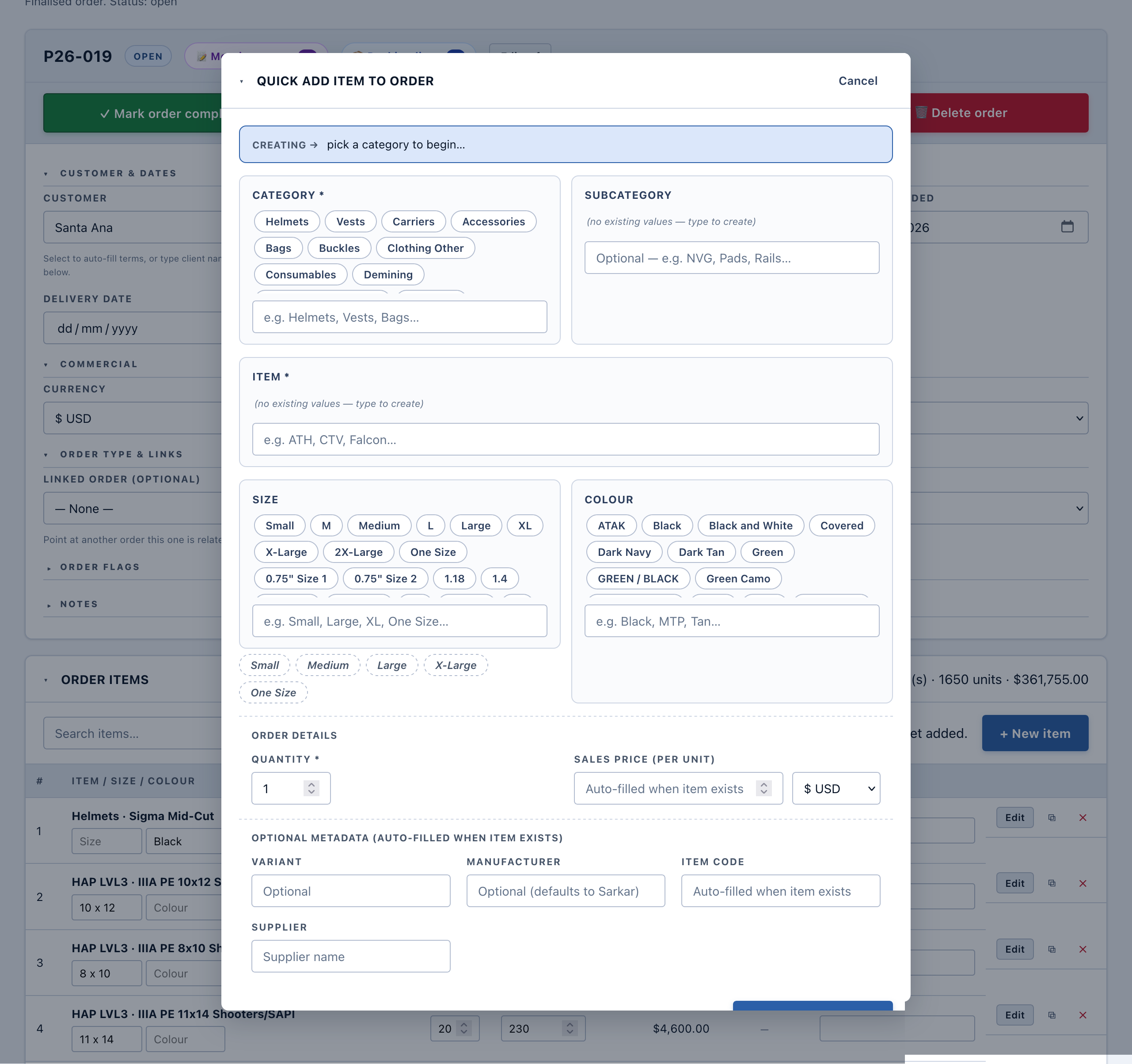
Order edit
The largest screen in the app. Header autosave, line items, attachments, serials, compliance, parcels, pallets — all inline.
Order progress timeline
Gantt-style view of every in-flight order with stage-colour segments, zoom, pan, drag-to-reorder.
Trim sheet library
Reusable BOM templates. Per-size length columns, colour-agnostic via the garment-colour mapping table.
US Licence tracking
Per-product balance + shipment ledger + inline shipment dialog that allocates the next number at log-time.
Item ↔ licence mapping
Translates custom catalogue items into broad licence families for CIPL output. Autosave dropdowns, category filter, search.
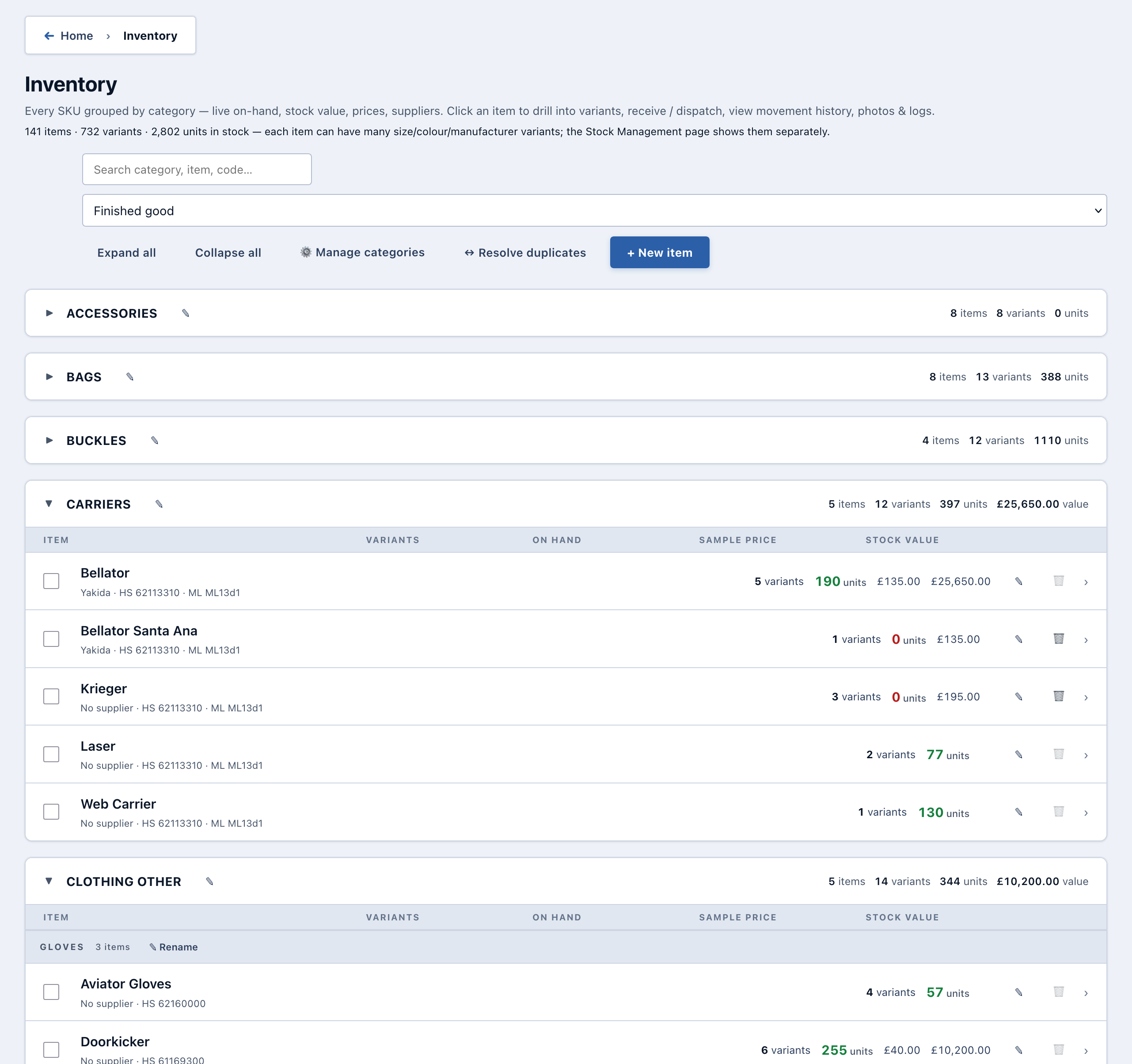
Catalogue
Three-tier hierarchy with inline rename, copy/merge tools, variant drawer, image upload, recipe-book PDF.
Data audit
One page that flags every missing-data row in the system — missing weights, missing HS codes, orphaned stock.
CIPL generator
Commercial invoice + packing list. Two-page PDF, preview mode, licence-aware naming overrides.
Gallery Screenshots
A walk-through of the live UI. Click any tile to open the full-size image; click the underlined URL to jump to the live page.